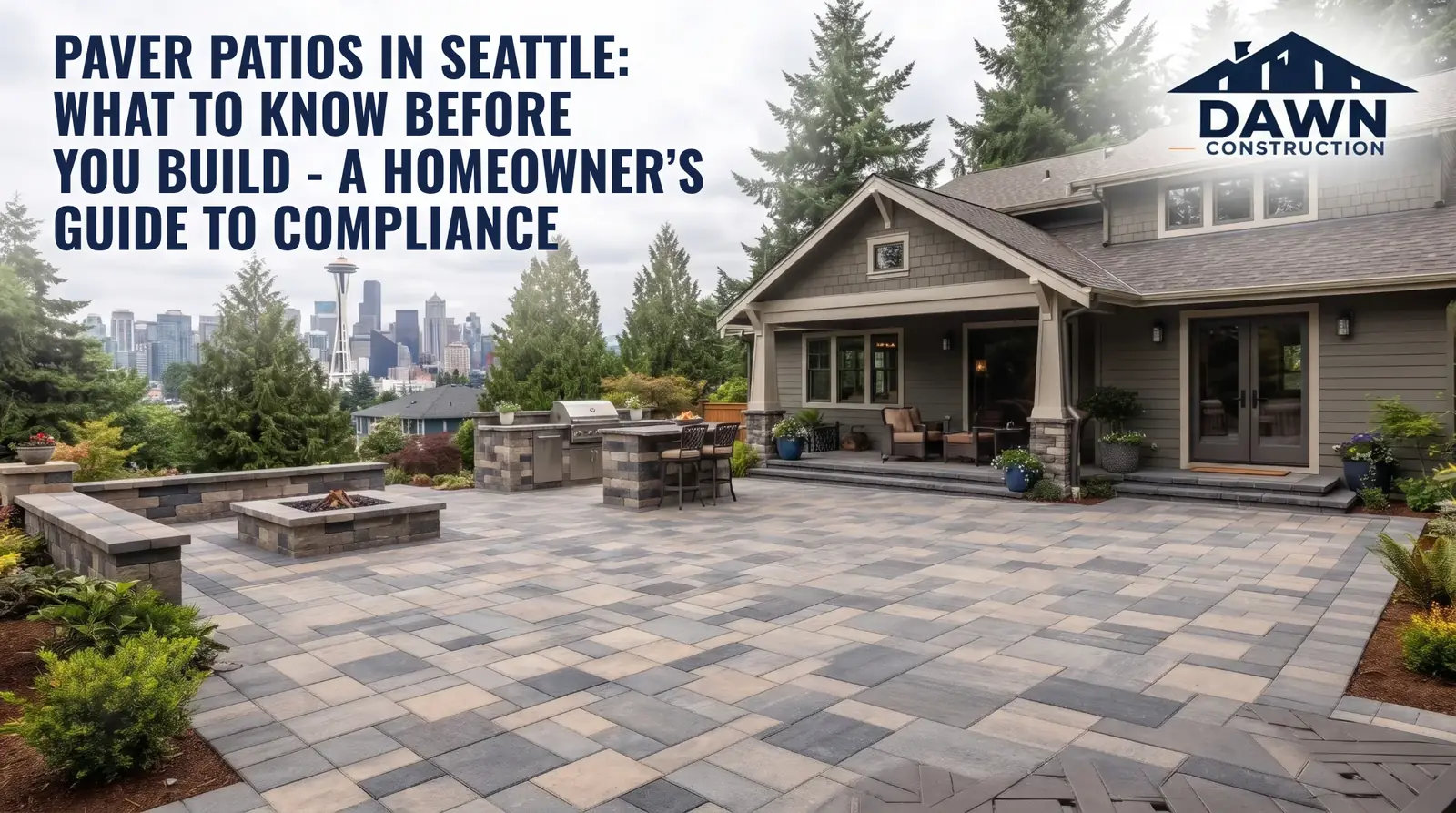
By Dawn Construction. Updated October 2026.
Are pavers a good patio choice for Seattle?
Pavers are one of the best patio choices for Seattle-area rain because the joints let them flex and individual units can be lifted and reset. What decides how long a patio lasts is underneath: a compacted base, a slope away from the house, and a plan for where the water goes.
Pavers are individual blocks, usually concrete or stone, laid side by side like a puzzle. Because each piece is separate, a paver patio can move slightly with the ground instead of cracking. This guide explains, in plain terms, how pavers handle our climate, which rules apply in Seattle, and how to keep a paver patio looking good through the wet season.
Paver patios in Seattle: key facts
| Question | Short answer | Source |
|---|---|---|
| Which way should the patio slope? | Away from the house. Near the house, the code requires at least a 2% slope, about 1/4 inch of drop for every foot | 2021 IRC R401.3 |
| Do I need a building permit? | Usually not for a patio at ground level. Seattle doesn't require one for platforms up to 18 inches high | Seattle SDCI |
| When do Seattle's rainwater rules apply? | When the project adds or replaces more than 750 sq ft of hard surface, such as a patio, driveway, or walkway | Seattle SDCI Stormwater Code |
| Do "permeable" pavers avoid those rules? | No. Washington still counts them as hard surface for these rules | Washington stormwater definitions |
| Biggest upkeep job here | Keeping moss out of the gaps between pavers and refilling the sand | Dawn Construction |
Pavers or a concrete patio?
Both work well here. The difference shows up over time, especially when the ground settles or something needs fixing.
| Paver patio | Concrete patio | |
|---|---|---|
| How it's built | Individual blocks on a packed gravel base, with sand in the gaps | One solid slab of poured concrete |
| When the ground settles | Blocks shift slightly; a low spot can be lifted and reset | The slab can crack; repairs often show |
| Look | Patterns, borders, colors, and textures | Clean and simple, with a few finish options |
| Upkeep | Sweep, remove moss from the gaps, refill the sand | Occasional cleaning; sealing if specified |
| Best for | Custom shapes, walkways, areas you may change later | Large, simple areas and hot tub pads |
See both side by side on our decks and patios page.
How is a paver patio built to last in our rain?
What you see on top is only the last layer. Most of the work is underneath, and in our wet soil each layer matters even more.
- Dig out the area. Soft topsoil and roots are removed, because they squash down and rot over time.
- Shape the ground to slope. The dirt underneath is shaped so the finished patio tilts slightly away from the house.
- Build a packed gravel base. Crushed stone goes in a few inches at a time, and each layer is packed hard with a machine. This is what keeps the patio from sinking when the ground is soaked.
- Add a thin, level layer of sand. The pavers sit on this smooth layer.
- Lay the pavers and lock the edges. The blocks are set in the pattern you chose, and a border (called an edge restraint) is fixed along every open side so the patio can't spread apart.
- Fill the gaps with sand. Sand is swept into the joints between the blocks and packed in, so the pavers lock together into one surface.
Where does the rainwater go?
Drainage is the first thing to plan, not the last. If water runs toward your house, it can end up against the foundation and in a crawlspace or basement.
The building code requires any hard surface within 10 feet of the house, like a patio, to slope at least 2% away from the building. In plain terms, that's about 1/4 inch of drop for every foot, or roughly 2 1/2 inches over 10 feet. You barely notice it when you walk on it, but rain notices.
We also plan:
- Where the water ends up: a lawn, a planting bed, or a drain, not against the house or into a neighbor's yard.
- How the patio meets the deck: so rain coming off a deck above doesn't collect in puddles on the patio below.
- Downspouts: pointed so roof water doesn't pour onto the patio and wash out the sand between the pavers.
Planning a path too? See our guide to paver walkways and paths.
Are permeable pavers worth it in Seattle?
Permeable pavers have wider gaps filled with small gravel instead of sand. Rain soaks down through the gaps into a deep gravel layer underneath, instead of running off the surface. They can cut down on runoff, but they only work where the soil below can absorb water. Some Seattle soils, especially dense clay, drain too slowly.
One thing surprises many homeowners: even though water soaks through them, Washington's rainwater rules still count permeable pavers as "hard surface." So a large permeable patio can still trigger Seattle's rainwater requirements, explained below.
Do you need a permit for a paver patio in Seattle?
Usually not a building permit, but the size of the patio matters.
| Your patio | What applies | Source |
|---|---|---|
| At ground level, up to 18 inches high | Generally no building permit | Seattle SDCI |
| Adds or replaces more than 750 sq ft of hard surface | Seattle's rainwater (stormwater) rules apply | Seattle SDCI |
| On or near a steep slope, wetland, or stream | Check with the city first; these are protected "critical areas" | Seattle SDCI |
| Raised patio with retaining walls, or a deck over it | Building permit rules for decks and structures apply | Seattle SDCI |
What "stormwater rules apply" means for you: when a project adds or replaces more than 750 square feet of hard surface, Seattle wants to know how the extra rainwater will be handled on your property, for example by letting it soak into the ground or directing it to a proper drain. That usually means a simple drainage plan as part of the paperwork. For a sense of size, 750 square feet is about a 25 by 30 foot patio, and the total includes any new walkways or driveway in the same project.
Rules differ in other cities, so we check yours at the free estimate. Building a deck too? See deck permits in Seattle.
How do you care for a paver patio in the Pacific Northwest?
Our damp, shady yards are perfect for moss. A little care each year keeps a paver patio safe to walk on and looking new.
| What to do | When | Why it helps |
|---|---|---|
| Sweep up leaves and needles | Often in fall | Wet leaves feed moss and leave stains |
| Remove moss from the gaps | Fall and spring | Moss holds water and pushes the sand out |
| Refill the sand between pavers | Whenever the gaps look low | Keeps the blocks locked together |
| Look for sunken spots | After the rainy season | A low spot can be lifted and fixed before it spreads |
| Point downspouts away | All year | Pouring water washes out the sand and the base |
Go easy with a pressure washer: a strong blast can wash the sand right out of the gaps.
What our customers say
"I had a very good experience with Dawn Construction. We agreed on a price to demolish my old patio and to construct a new one. They came by every day to check on the progress and to see if I had any questions. My patio was finished in a very timely manner and it turned out beautiful!"
Jackie P., Google review
Paver patios in Seattle: local details
- Shady yards under evergreens: expect more moss between the pavers and plan a yearly cleanup.
- Hillside lots: steep or protected slopes may need a check with the city before any digging.
- Large patios: past 750 sq ft of new or replaced hard surface, Seattle's rainwater rules apply.
Have an older deck next to your patio? Read deck refinishing vs replacement.
FAQ
Are pavers better than concrete for a patio in Seattle?
Pavers handle ground movement better, because each block can shift slightly and be reset. Concrete is one solid slab that can crack. Pavers need a little more upkeep in the gaps; concrete needs less.
Do I need a permit for a paver patio in Seattle?
Usually not a building permit for a patio at ground level. If the project adds or replaces more than 750 square feet of hard surface, Seattle's rainwater rules apply and you'll need a plan for where the water goes.
Do permeable pavers count as hard surface?
Yes. Even though water soaks through them, Washington's rainwater rules count permeable pavers as hard surface.
Which way should a patio slope?
Away from the house. Near the house, the code requires at least a 2% slope, which is about 1/4 inch of drop for every foot.
How do I get rid of moss between pavers?
Sweep out leaves and debris, remove the moss from the gaps, and refill the sand. Trimming branches that shade the patio helps it dry out faster.
Can a sunken paver be fixed?
Yes. The pavers in that spot can be lifted, the base underneath corrected, and the same pavers put back, without redoing the whole patio.
Planning a paver patio?
Dawn Construction builds concrete and paver patios, on their own or together with a deck, across Greater Seattle. Book a free estimate and we will plan the base, slope, and drainage for your yard.
Sources
- Seattle SDCI, Stormwater Code: https://www.seattle.gov/sdci/codes/codes-we-enforce-%28a-z%29/stormwater-code
- Seattle SDCI, Decks: https://seattle.gov/sdci/permits/common-projects/decks
- ICC, 2021 International Residential Code, Chapter 4, Section R401.3 Drainage: https://codes.iccsafe.org/content/IRC2021P2/chapter-4-foundations