By Dawn Construction. Updated November 2026.
How do you choose a contractor in Seattle?
Before you hire a contractor in Seattle, look them up on Washington L&I’s Verify tool to confirm an active registration, bond, and insurance. Then get several written estimates, a written contract with a clear scope and payment schedule, the required lien disclosure, and lien releases as you pay.
Washington requires construction contractors to register with the Department of Labor & Industries (L&I). That registration is your first and easiest check, and it takes about a minute online.
The 8 checks at a glance
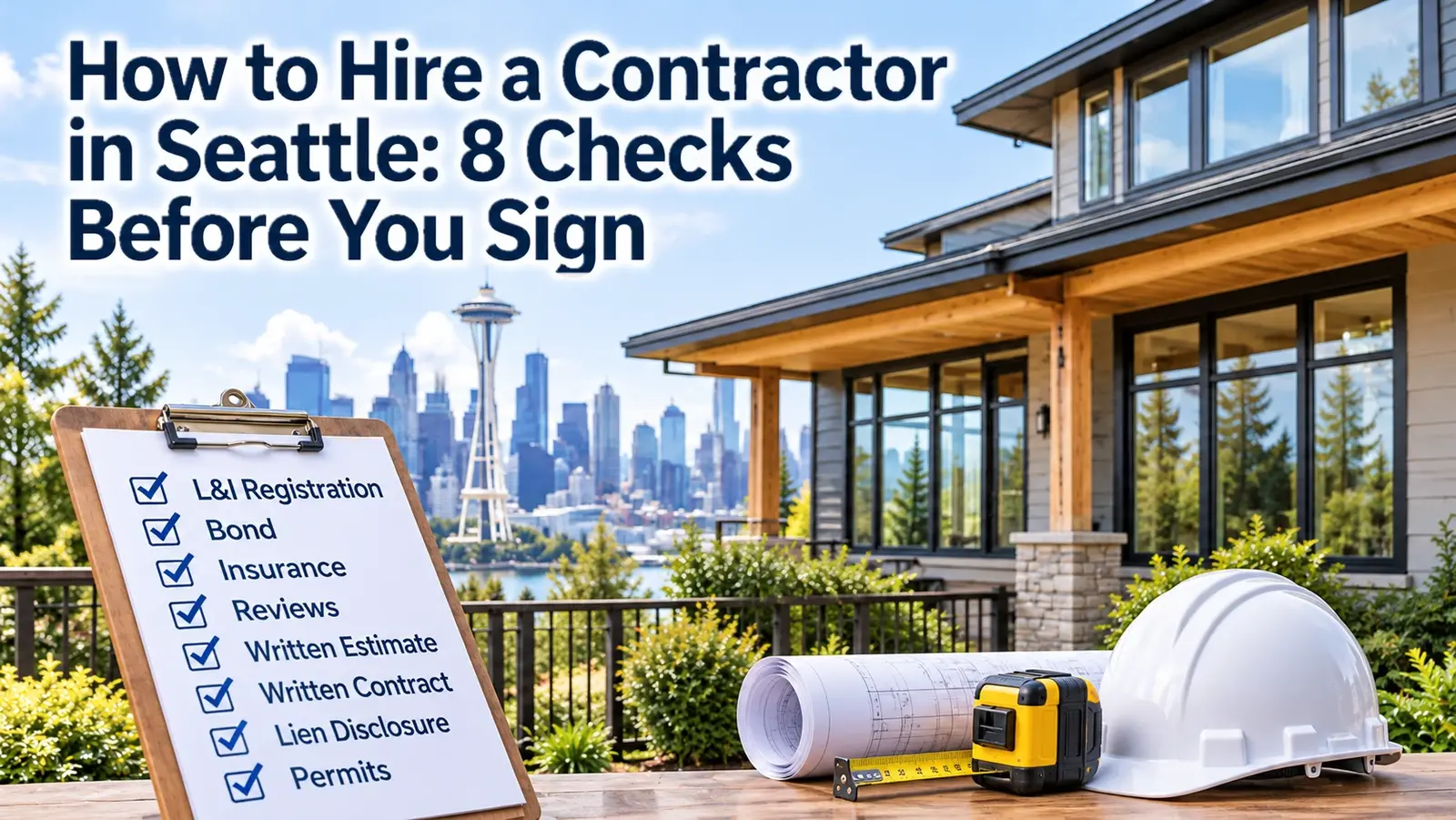
| Check | What to look for | Why it matters |
|---|---|---|
| 1. L&I registration | Active, not suspended or expired | Shows the contractor is registered to work in Washington |
| 2. Bond | A current bond on file with L&I | Gives you a possible source of recovery if the job goes wrong |
| 3. Insurance | Current liability insurance | Protects your home if something is damaged |
| 4. Reviews | Recent reviews on Google and other sites | Shows how they treat customers like you |
| 5. Written estimate | Itemized scope, not one number | Lets you compare bids fairly |
| 6. Written contract | Scope, materials, timeline, payment schedule | Prevents “I thought that was included” surprises |
| 7. Lien disclosure | A written disclosure about liens | Required by Washington law for many home jobs |
| 8. Permits | Who pulls them, and when | Unpermitted work can cause problems when you sell |
1. Check their L&I registration
Go to L&I’s Verify tool and search the company name or registration number. Make sure the registration is active and the name matches the company on your estimate.
While you’re there, look for any listed problems. A contractor who can’t give you a registration number, or whose number doesn’t match, is a reason to stop.
2. Make sure they’re bonded
Washington requires registered contractors to keep a surety bond: $30,000 for general contractors and $15,000 for specialty contractors. A bond can give you a place to recover money if a contractor doesn’t finish the job or breaks the contract.
A bond isn’t insurance, and it has limits, so it doesn’t replace a good contract. But a contractor without a current bond shouldn’t be working on your home.
3. Confirm their insurance
Ask for proof of current liability insurance, and check that the dates cover your project. Insurance protects your home if something is damaged during the work. L&I’s Verify tool also shows whether insurance is on file.
4. Read recent reviews
Look for recent reviews from homeowners with projects like yours. Pay attention to how the company responds to problems, not just the star rating. A few honest mixed comments are normal; a pattern of unfinished jobs or no-shows is not.
5. Get written, itemized estimates
Get at least two or three estimates for bigger projects. Each one should list the work, the main materials, and what’s not included. That makes it easy to compare. A very low bid with a short description often means something is missing.
6. Put everything in a written contract
A good contract spells out:
- The scope: exactly what will be done, room by room.
- Materials: brands or grades for key items like cabinets, tile, decking, or roofing.
- Timeline: start date and an estimated finish.
- Payment schedule: payments tied to finished stages of work, not large amounts up front.
- Changes: how change orders are priced and approved, in writing.
- Warranty: what the workmanship warranty covers and for how long.
7. Get the lien disclosure and lien releases
In Washington, subcontractors and suppliers who aren’t paid can file a lien against your property, even if you paid your contractor. That’s why state law requires contractors to give homeowners a written disclosure about liens on many residential jobs.
To protect yourself, ask for lien releases from the contractor, and from major suppliers and subcontractors, as you make payments.
8. Ask who handles the permits
Ask which permits your project needs and who will file them. A professional contractor should know the rules in your city and schedule the inspections. Be careful if someone suggests skipping a permit that’s required: unpermitted work can cause problems with insurance and when you sell.
Red flags to watch for
| Red flag | Why it’s a problem |
|---|---|
| No registration number, or it doesn’t match | You can’t confirm they’re registered |
| Cash only, or a large deposit before any work | Leaves you with little protection |
| Pressure to sign today | Good contractors give you time to decide |
| No written contract | Nothing to hold them to |
| “We don’t need a permit” for structural, wiring, or plumbing work | Can cause problems later |
| Door-to-door offers after a storm | A common sign of short-term operators |
Questions to ask before you sign
- Can I see your L&I registration number?
- Who will be on site every day, and who do I call with questions?
- Which permits does my project need, and who files them?
- What does your warranty cover?
- How do you handle changes and surprises found during the work?
- Will you provide lien releases as I pay?
FAQ
How do I check if a contractor is licensed in Washington?
Search the company on L&I’s Verify tool. It shows whether the registration is active, and whether a bond and insurance are on file.
How much bond does a contractor need in Washington?
General contractors must keep a $30,000 bond and specialty contractors a $15,000 bond with L&I.
What is a lien disclosure?
It’s a written notice explaining that unpaid subcontractors and suppliers can file a lien on your property. Washington requires contractors to provide it on many residential jobs.
How many estimates should I get?
For bigger projects, two or three written, itemized estimates make it easier to compare scope and price fairly.
Is it a red flag if a contractor asks for a big deposit?
A large payment before any work starts leaves you with little protection. Payments tied to finished stages of work are safer.
Who should pull the permit?
Usually your contractor, who should know your city’s rules and schedule the inspections.
Looking for a contractor you can check?
Dawn Construction is a registered Washington contractor, WA Lic. #DAWNCCW747K2, with offices in Renton and Mukilteo. Look us up on L&I’s Verify tool, read our reviews, and book a free in-home estimate with a written quote.
Sources
- Washington L&I, Verify a Contractor: https://lni.wa.gov/Verify
- RCW 18.27.040, Contractor bond requirements: https://app.leg.wa.gov/rcw/default.aspx?cite=18.27.040
- RCW 18.27.114, Disclosure statement required (residential construction): https://app.leg.wa.gov/rcw/default.aspx?cite=18.27.114