By Dawn Construction. Updated October 2026.
Which decking lasts longest in Pacific Northwest rain?
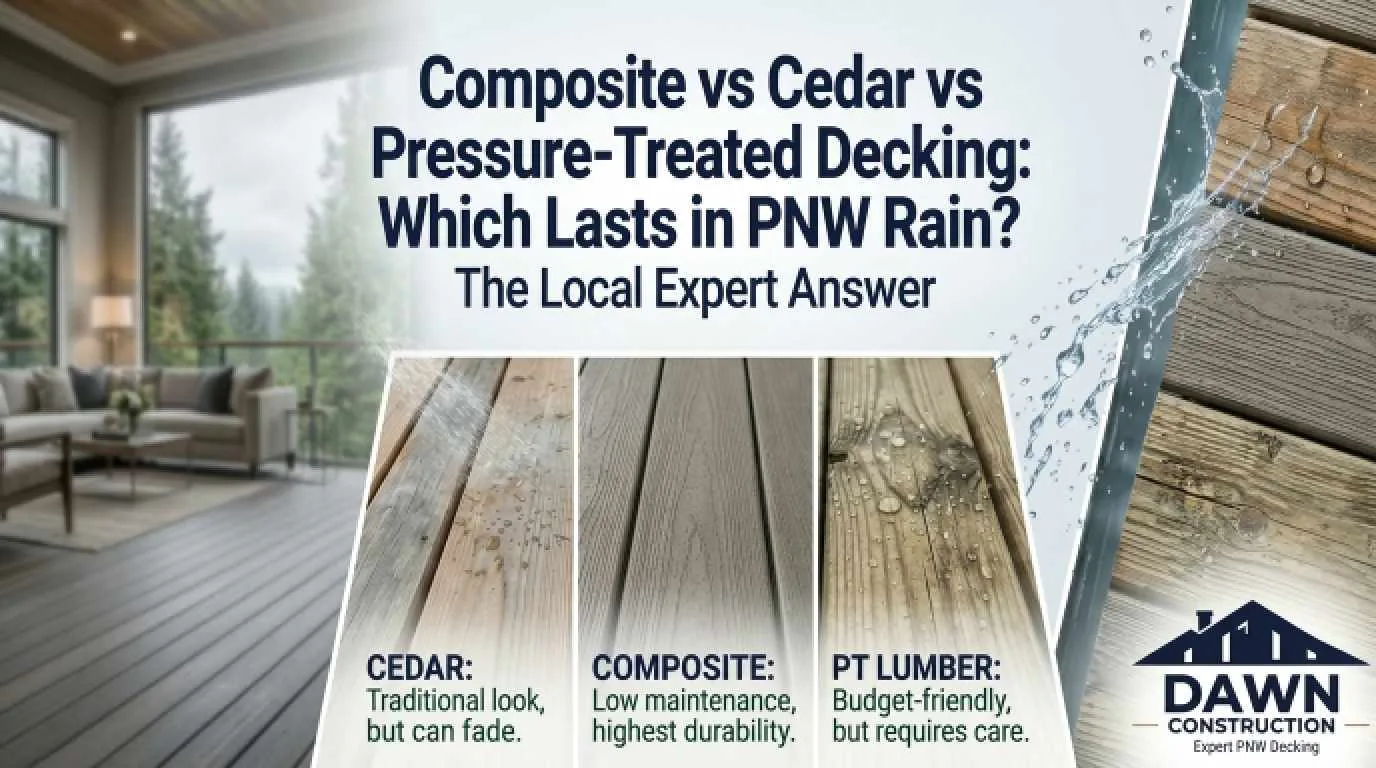
It depends on how much upkeep you want. Composite decking holds up best to Seattle-area rain with only washing, cedar looks and feels like real wood but needs a finish every few years, and pressure-treated lumber costs least up front but checks and splits unless you keep it sealed.
All three can last in this climate when built and maintained well. The bigger question is which kind of upkeep fits your household. You can see examples in our photos of composite and cedar decks we have built.
Decking at a glance for Seattle-area homes
| Capped composite | Western red cedar | Pressure-treated lumber | |
|---|---|---|---|
| What it is | Wood fiber and plastic with a protective plastic shell | Naturally decay-resistant softwood | Softwood treated with preservatives under pressure |
| Rot resistance | Boards do not rot; the cap resists moisture | Heartwood is resistant to very resistant; sapwood is not | Depends on the treatment level for the use |
| Upkeep in our rain | Wash at least twice a year | Clean and refinish; maintenance coats every 2 to 4 years for one penetrating finish | Clean and seal regularly |
| Look over time | Holds color under a fade warranty | Weathers to silver-gray if left unfinished | Weathers gray and can check and split |
| Manufacturer warranty | Trex: 25 to 50 years by product line | None on the wood itself | Varies by treater |
| Up-front cost | Usually highest | Usually in the middle | Usually lowest |
Why is rain the real test for a deck here?
Rain here is frequent more than heavy. Seattle-Tacoma averages about 39 inches of rain a year under the 1991 to 2020 NOAA normals, less than New York or Houston. But measurable rain falls on about 18 days in each of November and December.
Those many damp days keep deck surfaces wet for long stretches. Wet wood and organic debris feed mold and mildew, and wood that stays damp is where decay starts.
That is why material choice in the Seattle area comes down to one thing: how each deck handles staying damp from fall to spring.
How does composite decking hold up in the rain?
Capped composite is the lowest-maintenance choice for wet climates. A plastic cap wraps the board's top and sides and resists moisture, staining, and fading. Older uncapped boards had an exposed wood-fiber surface that grew mold and stained more easily.
Composite still needs cleaning. Fiberon's care guide says to clean as often as needed and at least twice a year, because mold grows on the pollen and debris that settle on the surface. Shaded decks under trees may need it more often.
Warranties are a real advantage. Trex's residential warranties run 25 years for Enhance, 35 years for Select, and 50 years for Transcend. Read the cleaning terms, since a stain claim requires following the maker's cleaning steps.
One thing composite does not change: the frame underneath is usually wood. Joists, beams, and posts still need the right treated lumber and must meet Washington's 60 psf deck load.
How strong is composite decking?
Composite boards are the walking surface, not the structure. The strength of the deck comes from the frame underneath, which is built for Washington's 60 psf deck load. Each composite brand lists the joist spacing its boards need; following it keeps the boards from bouncing or sagging. When you compare brands, compare their joist spacing and warranty, not just the color.
Is cedar a good choice for a deck in Washington?
Yes, if you like real wood and accept regular finishing. Western red cedar heartwood is rated resistant to very resistant to decay in USDA Forest Products Laboratory data. The decay resistance is only in the heartwood; the pale sapwood has little.
Cedar left bare weathers to a silver-gray color. That is a look some owners want, and the Western Red Cedar Lumber Association treats it as a valid choice.
A finish helps a cedar deck last. The USDA Forest Service says a finish reduces cracking, raised grain, and mildew, and that penetrating finishes perform better and are easier to reapply than paint or solid stain.
| Finish type | How long it lasts on a deck surface | Source |
|---|---|---|
| Water-repellent preservative (clear) | About 1 year | USDA Forest Service |
| Penetrating oil stain (semi-transparent) | Maintenance coat every 2 to 4 years for one product the association recommends | Western Red Cedar Lumber Association |
| Paint or solid stain (film-forming) | Not recommended for walking surfaces; harder to redo | USDA Forest Service |
What about pressure-treated lumber?
Pressure-treated lumber is softwood forced full of preservative, and it is widely used for deck framing. Used as decking, it is usually the lowest-cost option up front.
The treatment level matters. The American Wood Protection Association rates above-ground lumber as UC3B and ground-contact lumber as UC4A. Posts, ledgers, and wood close to soil or leaf litter should be UC4A or higher.
Treated boards still weather. Without regular cleaning and sealing, they turn gray and can check and split on the surface. For many homeowners, a pressure-treated frame with composite or cedar boards on top is the middle path.
Which one costs less over 10 years?
Up-front price and upkeep pull in opposite directions. Composite usually costs the most to install but needs only washing, while wood costs less but needs regular refinishing.
| Task | Capped composite | Cedar | Pressure-treated |
|---|---|---|---|
| Wash or clean | At least twice a year | Before each refinish | Before each seal |
| Refinish or seal | Not needed | Every 2 to 4 years with a penetrating finish | Regularly |
| Board replacement | Rare, and covered by warranty against defects | When boards split or decay | When boards split or decay |
Installed prices depend on the deck's size, height, and access. A free estimate is the fastest way to compare all three for your yard, and you can also check our financing options for a new deck.
How do you choose the right decking for your home?
Start with how you want to spend your weekends, then your budget.
- You want the least upkeep. Choose capped composite. Plan on a good wash twice a year.
- You want real wood and like the look of cedar. Choose cedar and budget for a penetrating finish every few years.
- You want the lowest up-front cost. Choose pressure-treated decking and plan to clean and seal it regularly.
- Your deck sits in deep shade or under trees. Lean toward capped composite, and keep board gaps clear so water drains.
Building a deck in the Seattle area: local details
The whole region builds to the same state rule: Washington decks must be designed for a 60 psf live load, higher than the 40 psf used in most states. That applies to the frame under every decking type. We build across the areas we serve in King and Pierce counties.
- Rainy season. November and December each average about 18 rain days, so the drier months are the easiest time to apply a finish.
- Permits. Height and size rules vary by city. In Renton, a deck more than 30 inches above grade needs a permit. See our guide to deck permit rules in Renton.
FAQ
Does composite decking grow mold in Seattle?
It can grow on the surface. Mold feeds on pollen, dirt, and debris that settle on the boards, not on the cap itself. Fiberon recommends cleaning at least twice a year.
Should I let my cedar deck turn gray?
You can. Unfinished cedar weathers to a silver-gray color. A finish still helps, since it reduces cracking, raised grain, and mildew.
Can you stain pressure-treated decking?
Yes, once the wood is dry enough to absorb the stain. Check the lumber tag and the stain maker's instructions before you start.
Is the frame under a composite deck also composite?
Usually not. Most composite decks sit on a wood frame. Posts and wood near the ground should be ground-contact (UC4A) treated lumber.
How long do composite deck warranties last?
It depends on the product line. Trex offers 25 years on Enhance, 35 years on Select, and 50 years on Transcend for residential decks. Check current terms before you buy.
Which decking is best for a shaded, damp backyard?
Capped composite resists moisture better than bare wood. Any deck in shade needs more frequent cleaning, because damp debris feeds mold.
Do I need a permit to replace my deck?
It depends on your city and the deck's height and size. In Renton, a deck more than 30 inches above grade needs a permit. See our guide to deck permits in Renton for details.
Ready to pick your decking?
Dawn Construction builds custom composite, cedar, and pressure-treated decks across King and Pierce counties. Book a free deck estimate and we will talk through upkeep and cost for your yard.
Sources
- Trex, limited warranty document (2023): https://images.trex.com/is/content/trexcompany/TXA1952_Warranty_Updates_2023_R2.2_withoutSIGpdf
- USDA Forest Products Laboratory, Comparative decay resistance of heartwood of native species: https://research.fs.usda.gov/download/treesearch/5731.pdf
- American Wood Protection Association, residential use category guide: https://awpa.com/images/standards/ResidentialInfographic2021.pdf